Why Should I Use Power BI?
Discover the top 25 benefits of using Power BI to visualise your data, provide actionable insights,
real-time analytics, and cost-effective solutions.
Power BI DAX Essentials
2 Days
Duration
Advanced
Level
AU$900+GST
per person
Course Overview
This intensive two-day Power BI DAX Essentials course is designed to establish a strong understanding of DAX fundamentals before progressing to more advanced calculations and techniques. The training is built around two core principles: practical application and active participation. Throughout the course, attendees will create DAX formulas in hands-on exercises, analyse the results, explore successful and unsuccessful outcomes, and gain a clear understanding of why certain approaches work better than others. Real-world, scenario-driven examples are used throughout every module to help reinforce concepts and ensure practical relevance.
By the end of the course, participants will have the confidence to develop DAX calculations that meet specific business requirements, apply proven techniques for troubleshooting and performance tuning, and utilise available resources to solve more complex analytical challenges. The course uses a single, consistent dataset from start to finish, allowing learners to focus on developing DAX skills and understanding key concepts without being distracted by changing data structures.
Audience
Power BI DAX Essentials is intended for business professionals – including those working in finance, marketing, operations, and other functional areas – as well as SQL Server reporting specialists who want to enhance their reports and dashboards through the creation of custom DAX-based calculations tailored to specific business needs.
Course Prerequisites
This course is ideal for individuals who have completed a foundational Power BI course or who already possess a solid understanding of data modelling principles. To gain maximum value from the training, participants should also be familiar with Excel formulas or have experience writing SQL queries, as these skills provide a useful foundation for learning DAX.
Registering Multiple Participants?
A 10% discount will be automatically applied when registering two or more participants for a course.
Do you have 5 or more participants?
Private courses are more cost-effective if you're looking to upskill 5 or more people.
Prerequisites
Power BI Advanced
Alternative Courses
Copilot Advanced

Next Steps...
SharePoint for Site Owners

Power Apps for Super Users

Course Modules
Module 1: Getting to know Data Analysis Expression (DAX) Language
- What is DAX?
- Understanding the Data types in DAX
- Understanding DAX Type Handling
- Understanding DAX Operator Overloading
- Learning DAX as Formula Language
- Vertipaq Engine in DAX
- Difference between DAX, EXCEL Functions and M
- Do's, Dont's and Best Practices in DAX
Module 2: Data Modelling Recap
- Fact vs Dimensions
- Understanding Schemas in Data Model
- Understanding Filter Propagation
- Understanding Data Denormalization
- Understanding Relationship Characteristics
Module 3: Calculated Columns and Measures
- Calculated Column and its Use Case
- When do Calculated Columns Fail
- Calculated Measure and its Use Case
- When to use Calculated Column vs Calculated Measure
Module 4: Basic DAX Functions
- Understanding Two Broad Categories of Functions in DAX
- Using SUM()
- Using DIVIDE()
- Using COUNT()
- Using DISTINCTCOUNT ()
- Finding Min, Max and Average
- Counting Rows
- Counting Blank Values
Module 5: Evaluation Contexts in DAX
- What are the Two Evaluation Contexts in DAX?
- What is Initial or Incoming Filter Context
- What is Row Context
- Filter Context vs Row Context
- Rules of Evaluation
Module 6: Table Functions
- Creating a Calculated Table
- Exploring Table Joins
- The Inner Join
- The Outer Join
- The Cross Join
- A Join on Unrelated Tables – TREATAS()
- Using GENERATE() for Joins
- Creating Summary Table for the Tequested Totals Using SUMMARIZE()
- Creating Summary Table Over a Set of Groups Using SUMMARIZECOLOUMNS()
- Improving TREATAS() using SUMMARIZE()
- Getting Top N rows of the Specified Table Using TOPN()
- Using VALUES()
- Using FILTER() as a Table Function
- Understanding Virtual Table Lineage
Module 7: Creating Date Table
- Creating Calendar Table using DAX
- Optimising Calendar Table using DAX
- Adding Date Columns
- Working with Fiscal Years
- Setting Sorting Options
Module 8: Basic Iterators
- Iterators vs. Normal Functions
- Using SUMX()
- Using COUNTX()
- Using AVERAGEX()
- Using MINX()
- Using MAXX()
Module 9: Variables in DAX
- Creating Variables
- Features of a Variable
- Location of Variable Evaluation
- Conditional Computations using Variables
- Increasing Code Readability
- Writing single and multi-line comments
Module 10: Advance Filtering in DAX
- Modification of Filter context using CALCULATE()
- Modification of multiple Filter using with CALCULATE()
- Mixing Filtering
- Using LOOKUPVALUE()
- Specifying the cross-filtering direction using CROSSFILTER()
- Activating Relationships with USERELATIONSHIP()
- Return all the rows in a table using All()
- Using ALLSELECTED()
- Using ALLEXCEPT()
- Modify how filters are applied using KEEPFILTERS()
- Using SELECTEDVALUE()
- Using CONCATENATEX()
Module 11: Context Transition
- Understanding Implicit Calculate in Measures
- Understanding Row to Filter Context transition
- Using CALCULATE() and CALCULATETABLE()
- Using EARIER() vs EARLIEST()
Module 12: Time Intellegence in DAX
- What is Time Intelligence
- Understanding Date table properties for Time Intelligence
- Aggregations Over Time
- Understanding Total Year till Date
- Understanding Month Till Date
- Understanding Quarter till Date
- Handling Fiscal Year
- Same Period Last Year
- Calculating Running Total
- Using Date Modifier DATESBETWEEN
- Shifting Forward/Backward in time using DATEADD()
- Using DATESINPERIOD()
- Using MAX or LASTDATE()
- Using FIRSTNONBLANK() and LASTNONBLANK()
- Working with Total Sales Rolling 90 Days
Module 13: Conditionals in DAX
- Using IF() statements
- Switching between Cases using SWITCH()
- Finding your Text
- What to do if your Text had One Value
- Concatenating Labels
- Using COALESCE()
Module 14: Hierarchies In DAX
- What are Hierarchies
- Understanding Parent-child Hierarchies
- Using Path Functions
Module 15: Other Functions
- Using RANKX()
- Understanding Dynamically controlling units
- Using COUNTA()
- Using MINA()
- Using MINAX()
Module 16: DAX Tools and Other Resources
- Understanding Common Errors and Causes
- Working with Error Debugging
- Understanding DAX Formatter
- Getting started with DAX Studio
- Downloading and Installing DAX Studio
- Connecting DAX Studio with Power BI
- Calculating Performance using Data Studio
- Understanding Power BI Helper
- Clearing the Cache
- Other DAX References
Upcoming Dates...
Related Courses...
Course Inclusions...
Certified Trainers
All our trainers are Microsoft 365 experts in their own right, and must first be qualified to teach in our own World Education Alliance (WEA) Training Certification Program before delivering any of our courses.
We feel that it is important that all of the trainers and instructors can take their real-world experiences into the classroom, in order to ensure that they are well equipped to respond to any queries and questions which may be put their way, as well as give accurate and relevant guidance in the most appropriate methods to leverage the technology which SharePoint and its related tools provide.
Course Materials Provided
Our Microsoft 365 courseware is known as being some of the best training materials in the world.
FREE Email Support
We offer free post-course support with all of our courses, available via email, telephone, or our Viva Engage community.
FREE Re-sits within 10 Months
Once you've attended any of our public courses, you can re-sit the same course as many times as you like within the next 10 months, as long as your re-sit course has reached the minimum number of paid attendees required to go ahead.
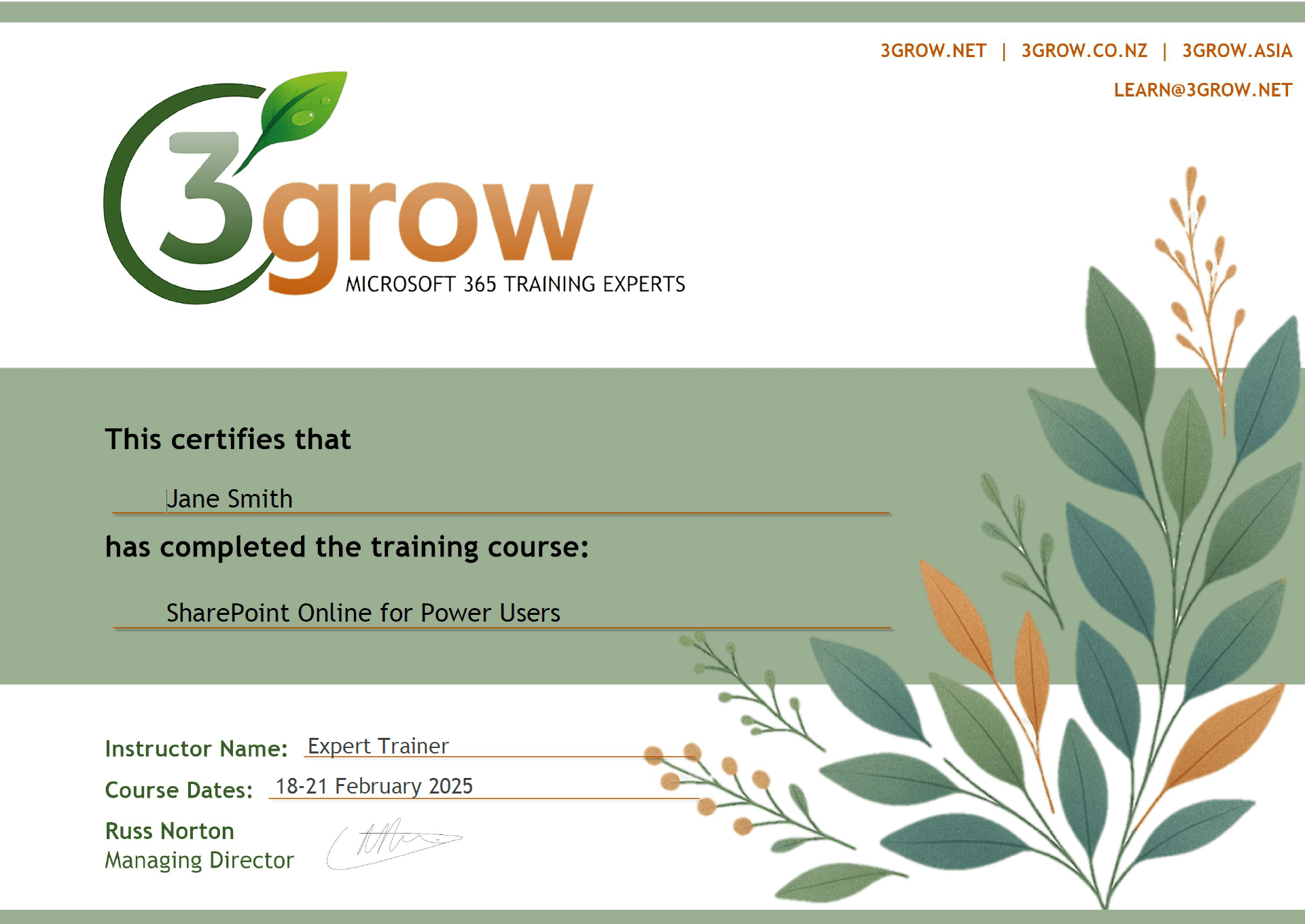
Certificate of Completion
Anyone attending a 3grow course will be provided with a personalised certificate of completion.
Get Hands-on Experience
All 3grow courses include plenty of hands-on experience, delivered via a combination of instructor-led follow-along demos and comprehensive lab exercises.
Personal Class Sizes
Although we allow a maximum of only 10 attendees on our public courses, the average is around 5 students, therefore each participant will leave the course feeling like they received the personal attention they deserve.
DAX Essentials FAQs
What is Power Query?
Power Query is a data connection technology that enables you to discover, connect, combine, and refine data across a wide variety of sources.
What is DAX?
DAX (Data Analysis Expressions) is a formula language used in Power BI for creating custom calculations in your data models.
What types of visualizations can I create in Power BI?
You can create various visualizations including bar charts, line charts, pie charts, maps, and more. The course covers how to customize these visuals to best represent your data.
Can I share my reports and dashboards with others?
Yes, Power BI allows you to publish and share your reports and dashboards with colleagues and stakeholders through Power BI Service.
What is data modeling in Power BI?
Data modeling involves creating relationships between different data tables and using DAX to create calculated columns and measures. This helps in organizing and structuring your data for better analysis.

